How to Book Camino Accommodations,
Bag Transport and Other Suggestions
Introduction - Sandy and I hiked the Camino de Santiago - French Way starting April 1, 2025. I booked everything in advance with my sister’s help. She had hiked the full Camino the two years prior. To book everything yourself for two weeks and set up baggage transfer, count on about 4 hours or so to do it. For the whole Camino, double that. Best I can tell, using an agency will at least double the cost of the accommodations. If you book yourself, you will also have better control of selecting where you want to stay. I can’t speak to the benefits of enlisting the help of an agency other than the convenience. Feel free to share this document with anyone who is considering hiking the Camio.


Buen Camino! (If you do not already know, that’s what everyone says on the Camino…kind of like good morning or good afternoon).
Jack
404-386-8642
First Decision: Where to Start - The traditional starting place for the Camino is in St. Jean Pied de Port in France (SJPDP) which is where we started. That said, there are 200 or so starting points in Europe and about 9 “official routes,” but the one starting in SJPDP is the most popular.
If you start in St. Jean, then after you arrive in Madrid, you take a train to Pamplona and you will spend the night in Pamplona such that you can catch the only bus to St. Jean the next morning which usually leaves at 10:00 AM or noon. You end up wasting an extra day in travel. Also, the first stage from St Jean is the most difficult on the entire Camino (4,000 ft climb followed by 1,600 ft descent). It is possible to break it into two segments, but you must get reservations for the interim accommodation well in advance. You can also catch a cab to cut out about 2/3 of the climb, which is what we did. If you are very fit, then no problem - go for it. Otherwise, do what we did or split it into two sections or just start in Pamplona.
A popular alternative starting point is Pamplona, which is the destination for the 3rd stage. If you have limited time, say 2 weeks, and don’t care about having to "start at the beginning" then I would recommend starting in Pamplona. The section between Pamplona and Burgos, then to Carrion (Stages 4 through 16) are though the heart of Spanish wine country and I think, on balance, the most beautiful section of the Camino. My personal preference is that this section is better than the last two weeks which ends in Santiago. I asked my sister, and she concurred that this is a better section than the last section ending in Santiago. A two-week trip starting in Pamplona would end in Carrion with a two-night stay in Burgos. From Carrion, you could catch a 3-hour bus ride back to Madrid to go home. If you want to start in St. Jean, then a two-week trip would finish in Burgos and then take a 2-hour bus to Madrid.
Getting There - Before starting to book accommodations, check flights to determine availability and when you want to travel. Once you settle on a departure time, you can book your accommodations with confidence. Booking accommodations is the most time-consuming part of the process, so you don’t want to book accommodations only to find out that you need to shift everything by one day. Flying to Madrid is most likely the best choice. Here are the two primary options that I discuss in this summary:
Option 1 - Atlanta>Madrid>Train to Pamplona>Bus to St Jean (you’ll end up back in Pamplona on the 3rd stage)
Option 2 - Atlanta>Madrid>Train to Pamplona (this is the recommended path for a 2-week trip)
The train station close to the airport is in Terminal 4 and is about 10 minutes from the arrival terminal (Likely Terminal 3) by taxi (about €20). A free shuttle is available which runs about every 15 minutes. From T4, you take a train to the main station which is Madrid Pta. Atocha - Almudena Grandes. This train takes about 30 minutes.
When we went to Pamplona, trains left Madrid Pta. Atocha - Almudena Grandes at 10:32, 11:30, 12:05 and 2:47 PM. About €25 to €85 depending on several factors. Be sure to book a fare that allows you to change your ticket. If the flight is running late and you’ll miss your train, then be sure to change before the train is scheduled to leave. Otherwise, you risk losing the fare.
Here is the link to book the train:
Search for tickets:
Departure: Madrid Pta. Atocha - Almudena Grandes
Arrival: Pamplona/Iruna
The bus to St Jean fills up, so be sure to make this reservation in advance if you plan to start there. Here is link to book the bus:
Next Decision: Accommodations (Book it or Wing it) - A purist pilgrim will carry everything and not make any reservations in advance. The advantage is that you have the flexibility to walk at any pace, but sometimes you might have to hike an extra 5 miles at the end of the day because everything is full or perhaps worse, sleep on a floor with 30 other people and endure a sleepless night of snoring. A lot of people do it that way and they exude a sense of pride for their hardships. "The Camino will provide," they proclaim, which it will in most cases. We preferred the more civilized approach. By booking in advance, you will have the best accommodations available and ensure that you have private rooms. For us, this outweighs the sense of pride one accrues from roughing it.
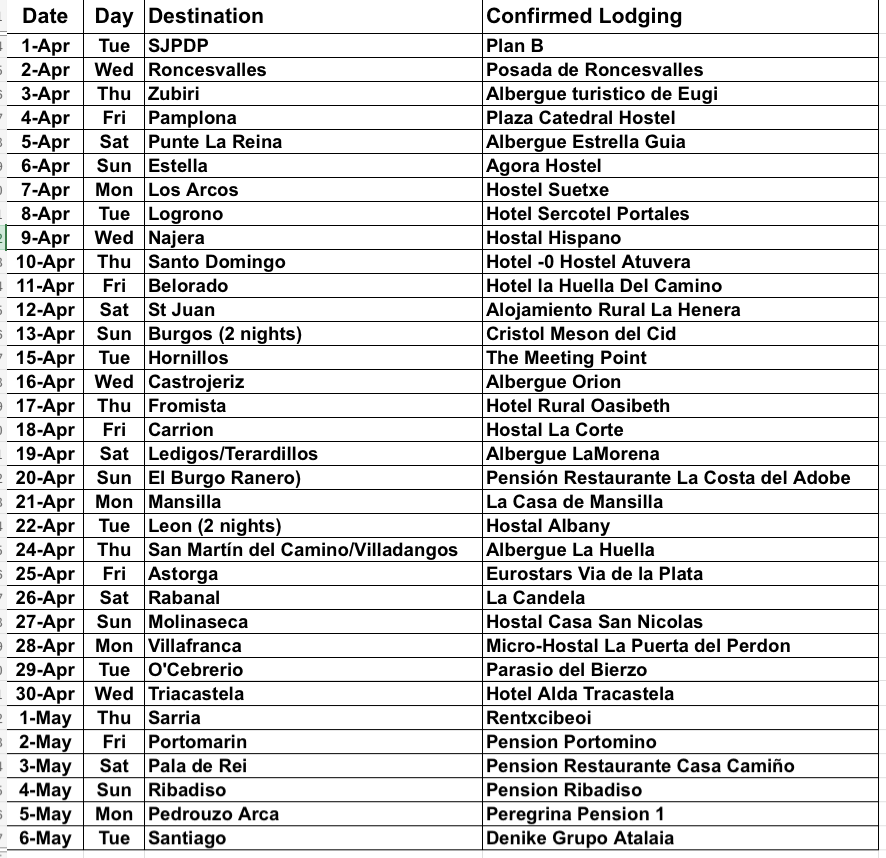
I have attached our itinerary, which has the places where we stayed and the places that my sister recommended (sometimes the same but often different because of availability). I have highlighted in green the places I would recommend staying if available and highlighted in red a couple of places to avoid. Places that are not highlighted at all are fine, but nothing to write home about.
We stayed in private rooms with private bathrooms for every night of our trip. The cost varied from $60 per night to $160 per night with the average somewhere around $100. I think that staying in a dorm setting would cost around $20 to $30 per night per person ($40 - $60 for two). Some people we spoke with complained that snoring was an issue in some of those settings. There is also a higher risk of bedbugs in the dorm settings, although we did not encounter anyone that had bedbugs. Some of the places that we stayed also offered dorm rooms, and they all looked very clean.
I used Booking.com for almost all the accommodations. I had a couple of exceptions where I had to contact a property directly, but most of the places worked well with Booking.com. At the completion, Booking.com provides a nice printout of every accommodation in chronological order so that you can double check the dates. I selected the “refundable” option where I could (all but one), which usually cost an extra $15 or so. Book as soon as you can because the best places book up first.
Here is a link to the spreadsheet with my accommodations and color-coded recommendations (open on a computer).
https://1drv.ms/x/c/2f2bdcbedb7dc093/EdYARuyUMOBPt21XtttgSH8BZ9mymw-wwCyIN4VDRnxhBA?e=gAvFLu
I am happy to send the file directly if I failed to include it with this overview.
Here is a summary of our bookings:
Bag Transport Service - What is the point of carrying your stuff when there is a perfectly good van that will do that for you? Exactly. The cost works out to about $6 - $8 per day. Here is what we used:
For the single section in France from St. Jean to Roncesvalles (over the border), you need to use this service (the office is a couple doors down from the Pilgrim Office in St. Jean). You set this up on the day of your arrival to St. Jean, the night before your first hike.
https://www.expressbourricot.com/luggage-transport/
For the remainder of the Camino (i.e., all of Spain), we used this service:
https://www.elcaminoconcorreos.com/en/
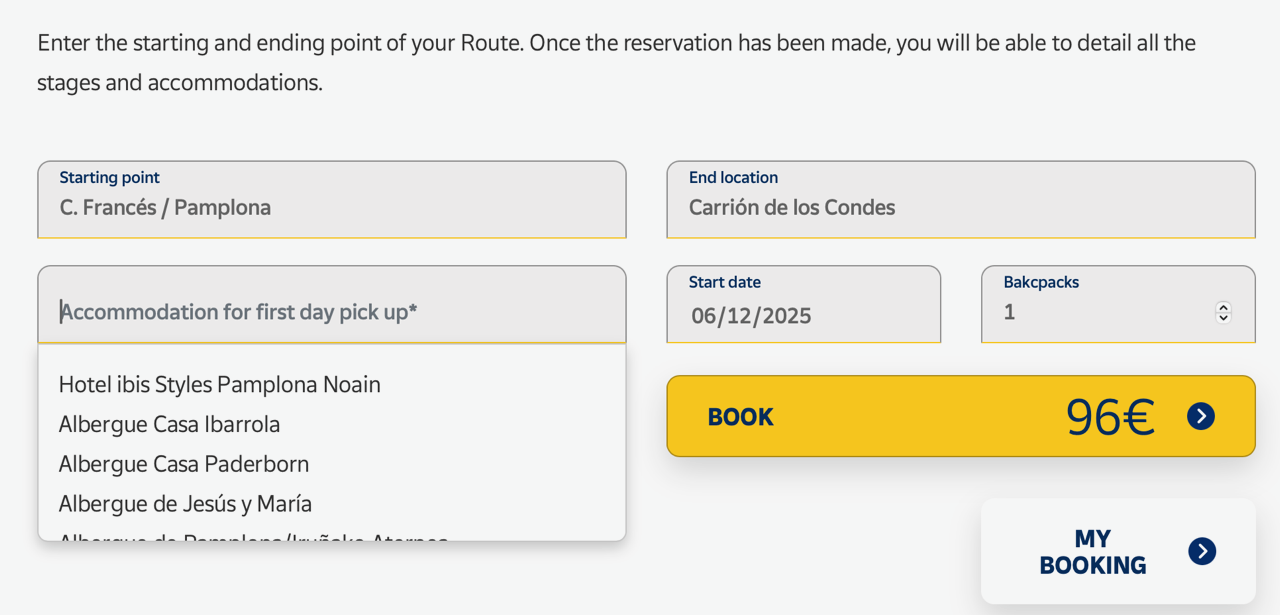
In using this service, you need to make sure that the place that you are staying is on their approved list. Their approved list is accessed on a drop-down menu for each stage after you book and pay for the service with the company. So, you must book the service to access the approved list. Best I can tell, you are able to get a refund in the event of cancellation, but don’t take my word for it. I had difficulty with payment to this company online and had to arrange to pay at the post office in Pamplona, which was not difficult. But they provided a link such that I could make my reservations for bag transfer and print in advance. I would set this up after all reservations are made. If it turn out that your accommodation is not on the drop-down list, then I would cancel that accommodation and rebook with one that is on the list.
Setting this up in advance is critical because if the accommodation is not on their approved list, then it is a hassle to work out where the bag is to be dropped off and retrieved. Not impossible, but a hassle. We had one case where there was no availability for anything on their list and it was a pain. So, best case is to just pick a place where they service. The good news is that the accommodations where you will most likely want to stay is probably on their list (i.e., around the old town center where the original path would have taken the pilgrims). The other important reason to do this before you leave is so that you can print out the label and have it laminated and ready to attach to your bag before you leave. Otherwise, you’ll need other find a place to print it and find some way to attach it (stress you don’t need upon your arrival). But the good news is that once you set it up, you don’t have to mess with it during the trip.
Example of Drop-down List:
Tag on the Bag (Recommend laminating before you leave):

I saw a lot of bags using Jacotrans for transport. No personal history with them, but here is the link:
https://www.jacotrans.es/tag/backpack-transport-in-the-camino-de-santiago/
Regardless, you must have your bag at wherever the host tells you to put it in the morning, in our case no later than 8:00 AM. Sometimes they pick up at 8:00 sharp and will not wait. Do not test fate, so don’t be late! Also, a basic American standard carry-on bag is the size limit for Correos. Some other services take larger bags. But you really do not need any more space than a regular carry-on.
Training / The Option for Bus or Taxi - It’s best to train if you can. On average, the Camino is about 15 miles per day. Some days are longer, some shorter. If you want to ensure you are ready, then work up to hiking this distance several days in a row. If you are able to do this, then you are likely to be fine.
If you cannot hike that much and find that the stages are too long (or have a minor injury), then taking a taxi or bus for some or all a stage is perfectly acceptable. We did not train at all, but we were not hellbent on hiking every step. We took a taxi or bus when we were sore or needed a break. So, we hiked 300 miles out of the 500 miles we traveled, which we were happy with. If a bus is available, then that is the way to go for only about 3 euro for a full stage. If no bus is available, then consider a taxi. For taking a taxi for the full stage, it’s usually around 30 - 40 euro; less for shorter trips. Sometimes this works out better at the start of a stage and sometimes better at the end of a stage, based on the location of interim towns. But sometimes, for the last section of a stage, the taxi must travel to you, and it might be the same or more than taking a taxi for the whole stage. The bars will gladly make the call for you, which helps because they can accurately tell the driver where to pick you up.
Guidebooks/Maps - Order a guidebook or two. Several people I talked to consider A Pilgrim’s Guide to the Camino de Santiago (Camino Frances) by John Brierley to be “the Bible.” Honestly, I didn’t find it all that helpful in comparison to the apps. A lot of unnecessary details if you have the apps installed and it is heavy. The book I found most helpful is Camino de Santiago by Michelin. It has two pages for each stage (a map and an elevation profile), which is a nice overview. I took a photo of each page so that I would have it on my phone. Here is a link to that so that you can download the Michelin book. I highly recommend doing so such that you will always have navigation with you:
https://www.icloud.com/sharedalbum/#B1fGI9HKKGTE8Nr
Apps for Phone - These are the two apps we used.

The first is The Wise Pilgram. I found it useful to “find the trail.” It has an arrow which will always point to the trail, which is useful to ensure that you haven’t strayed off the trail. I also used Buen Camino which has useful videos of the upcoming places so you can get a sense for what is ahead. When you are making reservations, assuming you are doing that, the Buen Camino app has reviews by Pilgrims on the main places to stay and also, you can click a link to find the location relative to the trail. That is very useful.
Google Maps - Here is one final technical task that will make your life easier. You can download Google Maps to your phone for offline use. Also, in Booking.com, after all reservations are made, you can go to each accommodation, go to “Get Directions,” then go to “Open in…,” then “Open in Google Maps.” The location opens on your phone and you can save the location in a list (Camino, for example). That way, when you are walking into town at the end of a long day, you switch to Google Maps and just pick the location to guide you directly to your accommodation. Way better than doing this manually at the end of every day.
Facebook Group - The best Facebook group that I found is Camino Frances. It has up-to-date information on various topics. Worth joining.
Mobile Data eSIM - I tried to use the data card from Airalo (download app). It is relatively straightforward to install an eSIM purchased from Airalo. Unfortunately, it does not cover voice calls. I found that the ATT international data plan was better suited for our needs. If you can discipline yourself to use WhatsApp, and only use wifi, then the data card would be less costly.
Currency and Tipping - Euro is the only currency they like to see. Bring debit card so you can have cash when needed. Most places have a way to take payment just touching your phone or credit card. You will encounter a few places that need cash. Use debit card to withdraw Euro from a bank ATM. Tipping is not expected anywhere.
Day Pack - If you are using a bag transfer service then all you need is a small day pack to carry water, a snack and weather protection clothing. Figure this out before you leave. A “Camelback" bladder with tube feed helps keep you hydrated and is highly recommended.
General Clothing/Packing Tips - A word to the wise: bring less than you think you will need. You will not want to haul or shuttle a bunch of dirty laundry. Generally, you will wash underwear, socks and a shirt at night. Typically, you’ll use the room sink. A lot of places have radiator style drying racks. You’ll have a set of hiking clothes that you will wear at night for dinner that does not need to be washed daily. Crocs can be helpful for the occasional place that requires that you store your boots at the door. Recommend:
- 2 - hiking pants with zip off legs
- 2 - 3 short sleeve shirts
- 3 - 4 underwear
- 3 - 4 socks
- 1 hat
- Crocs (optional
- Small bottle of concentrated clothes washing soap (I prefer Dr. Bonner’s Peppermint - you can get a small 2 oz bottle at REI).
Weather Protection Clothing - Be sure to bring rain gear. Ponchos are great and better than a heavy raincoat. You’ll need rain pants regardless. If cold weather is a possibility, bring gloves and a warm hat (I brought neither and regretted it). Several layers of warm clothing better than one heavy one.
Walking Sticks - Highly recommend. At least half the time, you may not need them. There are slippery or steep sections where I would not want to walk without walking sticks. Remember you cannot check walking sticks in your carry-on bags.
Foot Care - I never experienced extremely sore feet from hiking until the Camino. The contiguous days of walking without a rest takes its toll. Even if you never get blisters (like us) there’s a good chance you will (like us). Take Compeed with different sizes (2 packs). Take blister wool. Take Arnicare gel to sooth sore feet at night. Training with long walks in advance will condition your feet and you will have less trouble on the Camino. Also, the moment you feel something odd in your shoe, stop and try to find the source. We both waited too long before figuring out we had blisters. Had we checked it out earlier, perhaps we could have cut it off at the pass. Of course, it goes without saying that you need to break in your hiking boots before the trip. A moderate lightweight waterproof boot is a good choice. I used these and I found them perfect for my needs:
Meals - A lot of places offer a “pilgrim meal.” This is usually 12 - 15 euro and includes two courses, a desert and a bottle of wine. Often the wine is good or great. Sometimes so-so. For breakfast, we usually found a “bar” which has what they call a tortilla, which is a quiche with potatoes mixed in (our go-to). Coffee and other items are available. For lunch, we either eat something we picked up at a grocery store or stop at a town and eat at a restaurant or bar.
Friends You Meet - For us, the best part of the trip was the people we met along the way. I kept a running list of everyone so that I could remember names. In the end, the list totaled almost 100 people from all corners of the globe. You see the same people again and again and find “your people.” A lot of people use WhatsApp as the default tool for keeping in touch on the trail and meeting for dinner. Others will connect in Facebook. We developed friends that we have already made plans to see again.
Fisterra - If you end your trip in Santiago, then a lot of pilgrims will take a bus to Fisterra for a two-night stay. We did this and really enjoyed it. If you elect to do this, let me know and I can provide some specific recommendations. You will also need to book a bus ticket there and it fills up. So, you will want to do this in advance. Here is the link:
https://www.monbus.es/en/routes/santiago-de-compostela-fisterra